
Site24x7 meets HaloITSM: Turn your monitoring alert into a HaloITSM ticket, automatically

Best practices to define SLOs that actually reflect user experience

A marathon runner who trains obsessively on a flat track will have beautiful split times right up until race day when they discover the actual course has hills. Although the preparation was real, their strategy was flawed.
This plays out in SLO teams more than anyone likes to admit. At first, numbers look fine and nothing has been trigg...
Free vs. paid website monitoring: When should you upgrade?

Free website monitoring tools can be genuinely useful. They're the right starting point for a side project, a small business website, or a team that just wants to know when their homepage goes down. But "free" always comes with trade-offs, and those trade-offs have a habit of revealing themselves at the worst possible moment: peak...
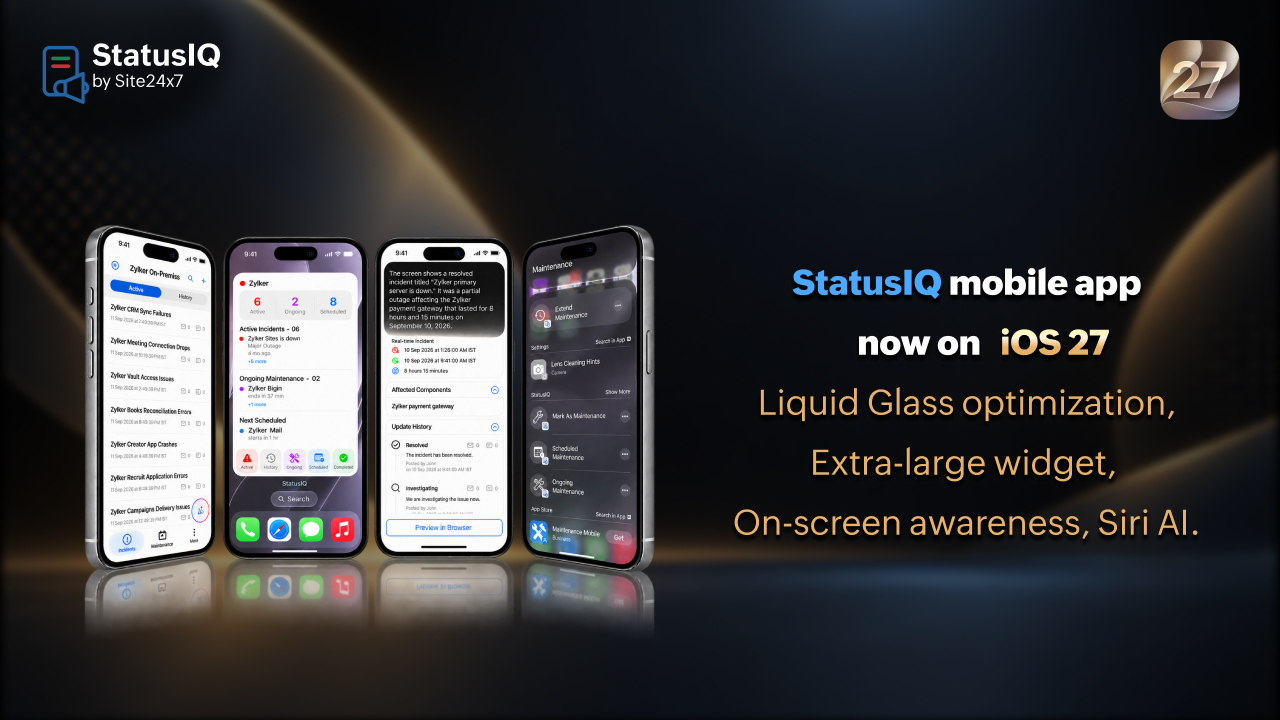
How we built iOS 27 into StatusIQ: Onscreen awareness, Siri actions through Spotlight, a one-stop widget for key information, and Liquid Glass optimization
The role of AI in website monitoring : How AI is rewriting the rules of website monitoring

A few years ago, this was just part of doing business online. Today, it’s a problem you can avoid, thanks to artificial intelligence. We’ve quietly reached an important turning point in website monitoring.
For most of the internet’s history, monitoring meant setting thresholds: set a number, wait for it to be crossed, get an alert, and ...
Which DNS monitoring tool do network admins recommend for detecting resolution failures and hijacking attempts?
Before getting into specific recommendations, it is worth separating the two distinct threats that network admins need to monitor for, because most tools handle one well and the other poorly.
Resolution failures are operational. A nameserver goes down. A zone transfer breaks. A record expires. A propagation delay means half your users i...
Cavalry or cattle? Let the machine decide

How to build a resilient incident management workflow using ilert

BGP monitoring: Fixing the blind spot in your digital experience monitoring stack

Without Border Gateway Protocol (BGP) monitoring, your digital experience monitoring (DEM) stack can't detect the route hijacks, leaks, or instability that prevent users from reaching your applications. Most DEM stacks miss this entirely, and that gap is where some of the most damaging, hardest-to-diagnose outages happen.
Every plan...
The 6 best DNS monitoring tools in 2026 (free and paid)

Most of the time, the culprit is invisible: a broken DNS record. When DNS works, nobody notices. But when it breaks, everything breaks — regardless of how healthy your infrastructure is underneath.
DNS breaks more often than most teams expect. Yet many teams still find out about DNS failures from users, not dashboards.